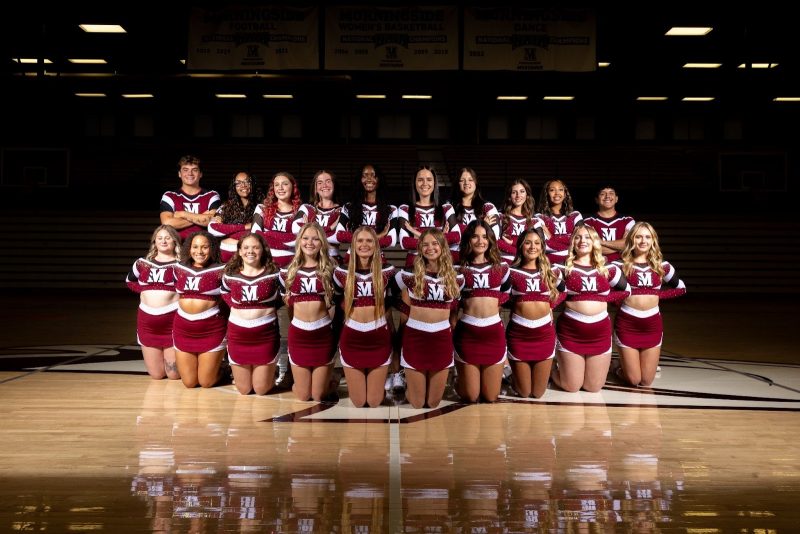
By Jesus Flores – The Mustangs cheer team were coming off one of the strongest years in program history, finishing in the top three in the GPAC and earning their place among the top teams. The team’s culture has elevated, alongside their confidence.
When they announced they would be leaving the NAIA competition to join the NCA the reaction was immediate.
Why leave?
The decision wasn’t easy or simple, and that’s exactly what makes this season different from all the previous ones. This move isn’t about chasing medals; it’s about pursuing something bigger.
Head coach, Maci Ohm explained that the choice was made in consideration to the program’s future. “The main reason our program decided to move from NAIA to NCA was to ensure greater consistency, transparency, and fairness in the scoring and judging process,“ Maci said. “We want to compete in an environment with standardized oversight and a clear competitive structure, while also prioritizing athlete safety and long-term program development.”
Behind the structured technicalities of judging systems however, there’s a much deeper emotional reality. The Mustangs want to be acknowledged. “NCA provides our team with a more structured and nationally recognized competitive platform,“ Maci said. “It allows us to showcase our program on a larger scale and improves our recruiting efforts.” For a small university, that exposure is crucial. It changes how athletes are noticed. It alters how future recruits view Morningside. It shapes the kind of legacy this team can leave behind.
The decision has spurred divided opinions.The Mustangs had just begun thriving in the NAIA environment, leaving now meant giving up a space they had worked hard to earn respect in and starting over on a national stage full of powerhouse programs.
Senior Alaundra Mayfield experienced many feelings towards the switch. “At first, it was bittersweet because we really built something special,” Mayfield said. “Last year, finishing in the top three in GPAC showed how far we’d come. Knowing that I get to end my cheer career by making the jump to NCA feels like going out with a bang. It’s a full circle moment.” For seniors like Mayfield, this change isn’t just about adjusting to a new scoring system. It’s about how their story will conclude. “As a senior, the move from NAIA to NCA is really exciting but also a bit nerve-racking because it’s such a big change,” she said. “It means higher expectations and new challenges, but I’m ready to grow and compete at that level most of all. It feels like this transition will put our program on the map.”
In the NCA, clean execution is prioritized over flash. Consistency matters more than taking risks. “In practice, expectations will shift toward refinement and accountability,” Maci said. “Every motion, stunt, and transition matters under NCA scoring. In competition, the expectation is to perform clean, controlled routines that reflect our true ability level.” That shift has already changed daily life in the gym. Athletes say practice now focuses on full-out routines, nonstop stunt repetitions, conditioning, and endurance work, all aimed at one goal. Delivering a routine that hits cleanly every time.
The physical grind is more demanding and the mental pressure is heavier. “There’s definitely more pressure because the level of competition is higher,” Mayfield said. “But that just adds to the excitement. I’m motivated by the challenge and eager to see how far we can push ourselves.”
What those outside the program might not realize is how overwhelming the transition can feel behind the scenes. “A lot of people don’t realize that this change affects us mentally just as much as physically,” Mayfield said. “We’re adjusting to new rules, higher standards, and a different level of visibility all at once. As seniors, it’s a huge responsibility, but it’s exciting to help set the tone for the program’s future.”
That visibility makes this move risky. In NAIA, the Mustangs were becoming known. In NCA, they are newcomers. They are stepping onto a floor with programs that already have strong reputations, trying to earn that same recognition in a single season. For Maci, discomfort is part of growth. “This transition marks a turning point for our program,” she said. “It allows us to compete in an environment that reflects our values of integrity, safety, and excellence. Over time, that will strengthen our culture, attract the right athletes, and increase our visibility.” She also highlighted that the choice was never just about prestige. “This decision was made with the best interests of our student athletes at heart,” Maci said. “Our goal is to provide a competitive environment that emphasizes fairness, safety, and long-term growth. Moving to NCA allows us to build a stronger, more sustainable future for Morningside Competitive Cheer.”
For many athletes, the excitement goes beyond rankings and score sheets. Team excitement ranges from the opportunity to compete in Daytona Beach, performing on a nationally recognized stage, and sharing the floor with some of the best collegiate cheer programs in the country. “My goals are to place top three at the competition and put our best routine on that mat,” said senior Madi Baker.
The team shares unified goals of proving that Morningside belongs, showing that a small university can make its mark on a big floor, and ensuring this move is remembered not as a gamble, but as a turning point.
The Mustangs could have chosen to stay in their comfort zone. They are instead deciding to trade certainty for potential. They’ve made this choice not only to compete, but to leave their mark.





Leave a Reply