Industrial motors are essential components in manufacturing plants, water treatment facilities, HVAC systems, mining operations, and many other industries. While motors are designed to provide reliable performance, starting them directly across the line can cause high inrush currents, mechanical stress, and unnecessary wear on equipment. This is where soft starters become valuable.
Selecting the right soft starter for your motor and load requirements is crucial for improving efficiency, extending equipment lifespan, and reducing maintenance costs. However, choosing the correct unit requires a clear understanding of motor characteristics, load demands, and application requirements.
This guide explains the key factors you should consider when selecting a soft starter and how to ensure optimal motor performance.
Understanding the Purpose of Soft Starters
Soft starters are motor control devices designed to gradually increase voltage during startup, allowing the motor to accelerate smoothly instead of receiving full voltage instantly. This controlled acceleration reduces electrical stress on the power supply system and minimizes mechanical shock to connected equipment.
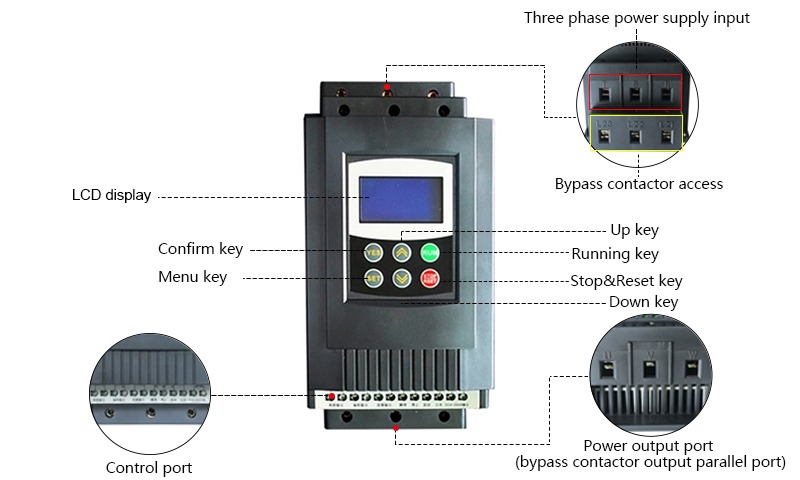
By controlling the starting current and torque, soft starters help protect motors, gearboxes, belts, pumps, and other mechanical components. They are particularly useful in applications where sudden starts can cause damage or operational issues.
Unlike variable frequency drives (VFDs), soft starters primarily focus on startup and shutdown processes rather than continuous speed control. Once the motor reaches full speed, most soft starters bypass the power electronics and allow the motor to operate directly from the supply.
Evaluate Your Motor Specifications Before Choosing Soft Starters
The first step in selecting a suitable device is understanding the motor’s electrical specifications. Every motor has a nameplate containing important information that must be matched with the soft starter.
Key motor specifications include:
- Rated power (kW or HP) 10 hp to 800 hp
- Rated voltage 220V/ 240V/ 380V/ 400V/ 460V/ 480V/ 690V
- Full-load current (FLC)
- Frequency (50Hz or 60Hz)
- Number of phases
- Duty cycle
The soft starter must be capable of handling the motor’s full-load current and starting requirements. Choosing a unit based solely on motor horsepower may lead to incorrect sizing, especially when operating conditions vary.
Manufacturers typically provide selection tables that correlate motor current ratings with appropriate soft starter models. Always verify current ratings rather than relying only on power ratings.
Analyze the Type of Load
Not all motor applications require the same starting characteristics. Understanding the load type is one of the most important aspects of proper soft starter selection.
Light-Duty Loads
Light-duty applications require relatively low starting torque and include:
- Centrifugal pumps
- Ventilation fans
- Blowers
- Simple conveyors
These loads generally accelerate quickly and place minimal stress on the motor during startup.
Medium-Duty Loads
Medium-duty applications include:
- Compressors
- Mixers
- Agitators
- Some conveyor systems
These systems require moderate starting torque and may have longer acceleration periods.
Heavy-Duty Loads
Heavy-duty applications demand higher starting torque and extended acceleration times. Examples include:
- Crushers
- Ball mills
- Loaded conveyors
- Positive displacement pumps
Heavy-duty loads require larger and more robust soft starter solutions capable of handling prolonged starting currents.
Matching the device to the load category ensures reliable operation and prevents overheating or premature failure.
Determine the Required Starting Current
One of the primary benefits of soft starters is reducing inrush current during motor startup.
A motor started directly online can draw six to eight times its rated current. Such high currents can create voltage dips, stress electrical infrastructure, and increase energy costs.
When selecting a soft starter, consider:
- Maximum allowable starting current
- Utility limitations
- Generator capacity
- Voltage drop requirements
- Motor starting frequency
Applications powered by generators often require stricter current limitation. In these situations, selecting a 3 phase soft starter with advanced current control features can significantly improve system stability.
Consider Start and Stop Functions
Different applications require different acceleration and deceleration profiles.
Standard Ramp Start
This is the most common method. Voltage increases gradually over a preset time, allowing smooth motor acceleration.
Current Limit Start
The soft starter limits current to a predefined value while the motor accelerates. This method is ideal for weak electrical networks or generator-powered systems.
Soft Stop
Soft stop functionality gradually reduces voltage during shutdown, minimizing hydraulic shock and mechanical stress.
Soft stop is particularly beneficial for:
- Water pumping systems
- Pipeline applications
- Conveyor systems
- Material handling equipment
Choosing the appropriate start and stop modes can improve operational reliability and equipment longevity.
Key Features to Look for in Modern Soft Starters
Modern soft starters offer a wide range of advanced features that enhance performance and protection.
Important features include:
Motor Protection Functions
Built-in protection can help prevent motor damage by monitoring:
- Overload conditions
- Underload conditions
- Phase loss
- Phase imbalance
- Overtemperature
- Locked rotor situations
Communication Capabilities
Industrial facilities increasingly rely on automation systems. Many soft starters support communication protocols such as:
- Modbus
- Ethernet/IP
- Profinet
- Profibus
These communication options allow operators to monitor and control equipment remotely.
Bypass Contactor
An integrated bypass contactor improves efficiency by reducing heat generation after startup.
Event Logging and Diagnostics
Advanced diagnostic tools simplify troubleshooting and reduce maintenance downtime by recording fault history and operating conditions.
Environmental Conditions Matter
The operating environment plays a major role in soft starter selection.
Before choosing a unit, consider:
Ambient Temperature
High temperatures can reduce performance and require derating.
Dust and Contaminants
Mining, cement, and industrial environments often contain significant dust levels. Appropriate enclosure protection is essential.
Humidity
High humidity may affect electronic components if proper protection is not provided.
Altitude
Higher altitudes can impact cooling efficiency and electrical performance, potentially requiring equipment derating.
Always review manufacturer guidelines regarding environmental limitations.
Sizing Soft Starters Correctly
Oversizing and undersizing are both common mistakes.
Problems with Undersizing
An undersized soft starter may experience:
- Excessive heating
- Frequent tripping
- Reduced lifespan
- Startup failures
Problems with Oversizing
While oversizing provides additional capacity, it can increase project costs unnecessarily and reduce startup optimization.
The ideal approach is to size the unit according to:
- Motor full-load current
- Load category
- Number of starts per hour
- Environmental conditions
Following the recommendations of an industrial automation manufacturer helps achieve the best balance between performance and cost.
Industry-Specific Applications
Different industries have unique requirements when selecting motor starting equipment.
Water and Wastewater Facilities
These facilities often prioritize soft stop functionality to eliminate water hammer and protect pipelines.
HVAC Systems
HVAC applications benefit from reduced mechanical stress and lower electrical demand during startup.
Mining Operations
Mining equipment frequently requires heavy-duty soft starters capable of handling high-inertia loads and demanding environments.
Manufacturing Plants
Manufacturers often seek communication-enabled devices that integrate with automated control systems and provide detailed diagnostics.
Understanding industry-specific requirements can significantly improve equipment selection.
Conclusion
Choosing the right soft starter requires more than simply matching motor horsepower. Engineers and facility managers must evaluate motor specifications, load characteristics, starting current requirements, environmental conditions, and desired control features.
Properly selected soft starters improve motor reliability, reduce electrical stress, minimize maintenance costs, and extend the lifespan of connected equipment. Whether the application involves pumps, compressors, conveyors, or heavy industrial machinery, investing time in the selection process helps ensure efficient and trouble-free operation.
By carefully analyzing your motor and load requirements and selecting a solution that aligns with operational demands, you can achieve better performance, improved energy efficiency, and long-term system reliability.